
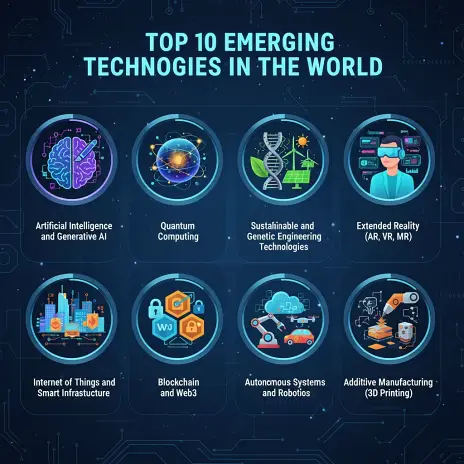
Technology is changing faster than ever, and 2026 is bringing exciting innovations in energy, healthcare, artificial intelligence, computing, and cybersecurity. Many technologies that were once limited to research labs are now moving closer to real-world use.
The World Economic Forum’s Top 10 Emerging Technologies of 2026 highlights technologies that could have a major impact over the next few years.
Top 10 Emerging Technologies of 2026
1. Everything-to-Grid Energy
Everything-to-grid technology allows electric vehicles, batteries, buildings, factories, and data centres to store electricity and send it back to the power grid when needed.
Key benefits:
- Better use of renewable energy
- Helps manage electricity demand
- Supports grid stability
- Makes batteries more useful
- Can reduce pressure on power plants
This technology could become especially important as electric vehicles and home battery systems become more common.
2. Direct Lithium Extraction
Direct lithium extraction (DLE) is a newer way to recover lithium from underground brines. Unlike traditional evaporation methods, DLE can potentially extract lithium much faster while using less land and water.
Why it matters:
- Supports EV battery production
- Can reduce water and land requirements
- Speeds up lithium production
- May strengthen battery supply chains
The technology is already moving toward industrial-scale applications.
3. Passive Radiative Cooling Materials
Passive radiative cooling materials can help buildings and other structures release heat without using traditional air-conditioning systems.
These materials could help reduce energy consumption, particularly in hot climates.
Potential benefits:
- Lower cooling costs
- Reduced electricity use
- More comfortable buildings
- Useful for hot and sunny regions
4. PFAS Destruction
PFAS are a group of highly persistent chemicals that can remain in the environment for long periods. New technologies are being developed to break down and destroy these chemicals rather than simply moving them from one place to another.
Potential uses include:
- Water treatment
- Industrial waste management
- Environmental cleanup
- Pollution reduction
PFAS destruction is important because effective treatment could help address long-lasting chemical contamination.
5. Precision Fermentation
Precision fermentation uses microorganisms to produce specific ingredients and biological products.
It can potentially create proteins and other useful materials without relying on traditional animal-based production.
Benefits of precision fermentation:
- Alternative protein production
- More efficient manufacturing
- Reduced dependence on animal agriculture
- Potentially lower environmental impact
It is becoming an important technology in food and biotechnology.
6. Exosome Drug Delivery
Exosomes are tiny biological structures that cells naturally use to transport molecules. Scientists are exploring their use as delivery systems for medicines.
The goal is to potentially deliver therapeutic substances more precisely to specific cells or tissues.
Possible applications:
- Drug delivery
- Cancer treatment research
- Gene-related therapies
- Regenerative medicine
This field is still developing, but it could become an important part of future medicine.
7. Personalized mRNA Cancer Vaccines
Personalized mRNA cancer vaccines are designed using information about an individual patient’s tumour. The goal is to train the immune system to better recognize and attack cancer cells.
Potential advantages:
- Personalized treatment
- Targets specific tumour mutations
- Uses mRNA technology
- Could improve cancer immunotherapy
Research is progressing toward larger clinical studies, although these vaccines are not yet a routine treatment for most cancers.
8. Quantum Simulation for Drug Discovery
Quantum simulation uses quantum computing techniques to model molecular behaviour. It could eventually help researchers understand complex chemical interactions and identify promising drug candidates.
Potential benefits:
- Faster drug research
- Better molecular modelling
- New possibilities for difficult diseases
- Improved understanding of chemical interactions
Commercial applications are still developing, but pharmaceutical companies are increasingly exploring quantum technologies.
9. World Models
World models are advanced AI systems designed to understand how the physical world works. Instead of simply recognizing information, they can learn relationships between objects, actions, environments, and events.
Potential applications:
- Robotics
- Autonomous systems
- Climate modelling
- Simulation
- AI training
World models could help AI systems make better predictions about situations they have not directly experienced.
10. Lattice-Based Cryptography
Lattice-based cryptography is a modern approach to cybersecurity designed to protect information against both traditional computers and future quantum computers.
As quantum computing develops, existing encryption methods may face new risks. Lattice-based methods are therefore becoming an important part of the move toward post-quantum security.
Why Are Emerging Technologies Important in 2026?
These technologies are important because they are moving from research and experimentation toward practical applications. The World Economic Forum notes that many of its 2026 selections are already entering commercial use or are approaching the point where they can scale.
They could influence:
- Healthcare and medicine
- Renewable energy
- Electric vehicles
- Food production
- Cybersecurity
- Artificial intelligence
- Manufacturing
- Environmental protection
- Scientific research
Future of Emerging Technology
The future of technology will likely involve several fields working together. AI, robotics, quantum computing, biotechnology, advanced materials, and clean energy can complement each other and create new solutions.
AI is also increasingly moving beyond software into physical systems such as robots and other intelligent machines.
Final Verdict
The Top 10 Emerging Technologies of 2026 show that innovation is expanding far beyond smartphones and traditional software. From AI world models and quantum drug discovery to clean energy, biotechnology, and post-quantum cybersecurity, these technologies could shape the way we live and work in the coming years.
For students, developers, businesses, and technology enthusiasts, learning about these emerging fields today can help prepare for the jobs and opportunities of tomorrow.
FAQs
1. What is the most important emerging technology in 2026?
AI-related technologies, clean energy, biotechnology, and quantum technologies are among the major areas to watch.
2. What are the top emerging technologies of 2026?
The World Economic Forum lists everything-to-grid energy, direct lithium extraction, passive radiative cooling materials, PFAS destruction, precision fermentation, exosome drug delivery, personalized mRNA cancer vaccines, quantum simulation for drug discovery, world models, and lattice-based cryptography.
3. Is quantum computing ready for everyday use?
Not yet. Quantum computing is advancing rapidly, but broad commercial benefits are still expected to take time.
4. Why are world models important?
They can help AI systems understand and predict physical environments, making them useful for robotics, simulation, and other real-world applications.
5. Will these technologies create new jobs?
Yes. Emerging technologies are likely to create demand for skills in AI, cybersecurity, biotechnology, robotics, energy, data science, and quantum cumputing.






1 thought on “Top 10 Emerging Technologies of 2026”