
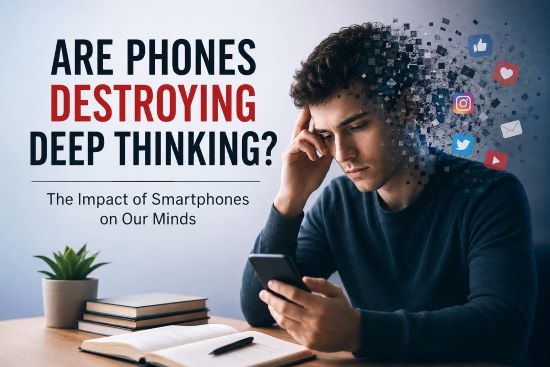
Smartphones have transformed modern life. They help people communicate instantly, access information within seconds, work remotely and stay connected across the world. Yet as screen time continues to rise, a growing concern is emerging among psychologists, educators and technology experts: are phones damaging our ability to think deeply?
Many people now struggle to focus on long tasks, read lengthy articles or sit quietly without checking notifications. Attention spans appear shorter, distractions are constant and uninterrupted thinking has become increasingly rare. While smartphones provide undeniable convenience, they may also be reshaping how the human brain processes information.
What Is Deep Thinking?
Deep thinking is the ability to concentrate on a single idea or problem for an extended period of time. It involves reflection, analysis, creativity and critical reasoning. Deep thinking allows people to solve complex problems, generate original ideas and make thoughtful decisions.
Historically, deep thinking has been essential for scientific discoveries, literature, innovation and intellectual growth. However, this type of focused mental engagement requires something modern smartphones often interrupt: sustained attention.
The Attention Economy
Most smartphone applications are designed to compete for attention. Notifications, short videos, social media feeds and endless scrolling mechanisms encourage users to remain engaged for as long as possible. Every vibration, alert or recommendation pulls the brain toward instant stimulation.
Over time, this repeated interruption can affect concentration. Instead of focusing deeply on one activity, people frequently switch between messages, apps, videos and online content throughout the day.
Common smartphone distractions:
- Constant notifications
- Endless social media scrolling
- Short-form video content
- Frequent app switching
This pattern trains the brain to expect constant novelty, making long periods of focus feel uncomfortable or difficult.
Signs of reduced attention span:
- Difficulty reading long articles
- Losing focus during conversations
- Constant urge to check the phone
- Trouble concentrating on work or study
Many experts believe this shift is gradually reducing humanity’s tolerance for slow, focused thinking
The Rise of Shallow Information Consumption
Smartphones have started a culture of rapid information consumption. While access to information has improved dramatically, deep engagement with that information has decreased.
Instead of reading full articles or researching topics carefully, users often rely on summaries, short clips and social media opinions. The brain adapts to this faster style of consumption and becomes less comfortable with complex or demanding material.
In many ways, modern digital habits prioritize speed over depth.
Smartphones and Memory Dependency
Smartphones have also changed how humans use memory. People no longer memorize phone numbers, directions, appointments or even basic facts because digital devices store that information automatically.
This reliance on technology is convenient, but it may reduce active memory usage over time.
Everyday examples of digital dependency:
- Using GPS for familiar routes
- Searching Google for simple facts
- Saving reminders for every task
Researchers describe this growing habit as digital dependency, where the brain outsources cognitive tasks to technology instead of practicing natural recall.
Creativity in the Age of Constant Stimulation
Creativity often develops during moments of silence, boredom and uninterrupted thoughts. Some of the most innovative ideas emerge when the mind has space to wander freely.
Smartphones have significantly reduced those quiet moments. Whenever boredom appears, most people immediately reach for their devices. Social media feeds, entertainment apps and short-form videos fill every spare moment with stimulation.
Without pauses for reflection, the brain has fewer opportunities to process ideas deeply or develop creative insights.
Social Media and Cognitive Overload
Social media platforms expose users to enormous amounts of information within minutes. Emotional posts, breaking news, debates, advertisements, entertainment and opinions compete simultaneously for attention.
This creates cognitive overload. The brain continuously absorbs and processes new input without enough time to rest.
Effects of cognitive overload may include:
- Mental fatigue
- Reduced productivity
- Poor concentration
- Increased anxiety
- Difficulty making decisions
The problem is not simply the amount of information available, but the nonstop pace at which it arrives.
Can Deep Thinking Be Restored?
The good news is that deep thinking is not permanently lost. The brain can adapt and rebuild focus through healthier habits and reduced digital dependence.
Simple ways to improve focus:
- Reduce unnecessary notifications
- Spend time away from screens
- Read books regularly
- Limit social media usage
- Practice focused work sessions
Protecting attention in the digital age requires conscious effort, but it remains entirely possible.