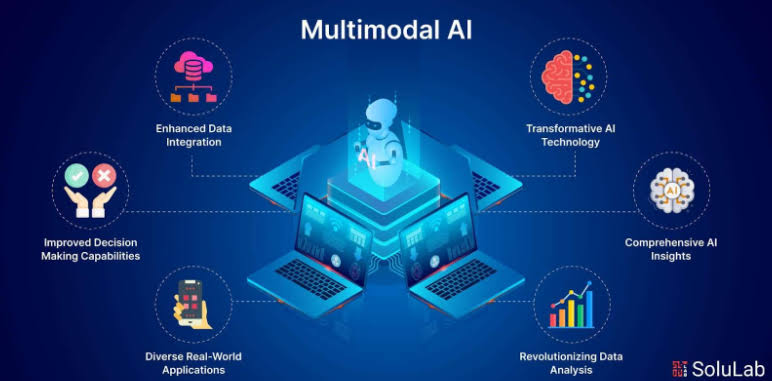
Multimodal communication is one of the most exciting developments in modern artificial intelligence. Instead of communicating through text alone, AI can understand and respond using text, voice, images, video, and other types of information.
This technology is making communication with AI more natural, faster, and easier. From virtual assistants and customer support to education and healthcare, multimodal AI is creating new ways for people and machines to interact.
What Is Multimodal Communication?
Multimodal communication means communicating through more than one type of information or communication method. In AI, it allows a system to understand and work with text, voice, images, video, and documents together.
For example, you can upload an image and ask a question about it using your voice. The AI can understand both the image and your spoken question and then give you an answer.
Simple Example
Imagine you show an AI a picture of a car and ask:
“What do you think about this car?”
The AI can:
- 👁️ Analyze the image
- 🎤 Understand your voice
- 🧠 Combine the information
- 💬 Give you a text or voice response
This makes communication with AI feel more natural, flexible, and human-like.
How Does Multimodal AI Communication Work?
Multimodal AI communication works by allowing an AI system to understand different types of information, such as text, voice, images, video, and documents. It combines this information to understand the user’s request and provide a useful response.
Simple Process
- User Provides Input
You can type a message, speak to the AI, upload an image, or share a document or video. - AI Processes the Information
The AI analyzes the different types of input and identifies important details. - AI Combines the Context
The system connects information from different sources. For example, it can understand a spoken question while also analyzing an uploaded image. - AI Understands the Request
The AI uses the combined information to determine what the user wants. - AI Generates a Response
It can respond with text, voice, an image, or another suitable format.
Example
Suppose you upload a photo of a product and ask by voice, “Is this suitable for my needs?” The AI can analyze the photo and understand your spoken question before generating an answer.
This ability to combine different communication methods makes multimodal AI more natural and interactive than traditional text-only AI.
Examples of Multimodal Communication
Multimodal communication is becoming common in everyday technology. It allows people to interact with AI using text, voice, images, video, and other forms of information.
1. AI Voice Assistants
You can speak to an AI assistant, ask questions, and receive a spoken response. Some systems can also use visual information during the conversation.
2. Image and Voice Interaction
A user can upload a photo and ask a question about it using voice. The AI can understand both the image and spoken question.
Example: Upload a picture of a car and ask, “What features can you identify?”
3. Video Analysis
AI can analyze videos to identify objects, activities, or important events and explain what is happening.
4. Education
Students can upload homework, diagrams, or charts and ask questions through text or voice. AI can then explain the information in simple language.
5. Customer Support
Customers can send messages, screenshots, photos, or voice recordings to explain a problem. AI can use this information to provide assistance.
6. Smart Cars
Modern vehicles can combine voice commands, cameras, screens, and sensors to provide a more interactive driving experience.
7. Business Communication
Employees can ask AI to analyze documents, presentations, images, spreadsheets, and meeting information and then summarize the results.
8. Translation
Multimodal AI can combine speech, text, and images to translate conversations, signs, documents, or other visual information.
Overall, these examples show how multimodal communication makes AI interaction more flexible and closer to the way humans naturally communicate.
Multimodal Communication vs Text-Based AI
The main difference between multimodal communication and text-based AI is the type of information they can understand and use.
Text-based AI mainly works with written messages, while multimodal AI can work with several types of information, including text, voice, images, video, and documents.
| Feature | Text-Based AI | Multimodal AI |
|---|---|---|
| Text | ✅ Yes | ✅ Yes |
| Voice | ⚠️ Limited | ✅ Yes |
| Images | ⚠️ Limited | ✅ Yes |
| Video | ⚠️ Limited | ✅ Yes |
| Documents | ✅ Yes | ✅ Yes |
| Multiple inputs | ❌ Limited | ✅ Yes |
| Natural interaction | Good | More natural |
| Real-world understanding | Limited | Broader |
Text-Based AI
Text-based AI requires users to communicate mainly through typing. It is useful for tasks such as:
- Writing content
- Answering questions
- Summarizing text
- Translation
- Chat conversations
Multimodal AI
Multimodal AI can combine different forms of information. For example, a user can upload an image, ask a question by voice, and receive a spoken or written answer.
Which Is Better?
Neither is better for every situation. Text-based AI is simple and effective for text-related tasks, while multimodal communication is more useful when a task involves images, voice, video, or multiple types of information.
As AI technology develops, multimodal communication is becoming an important part of more natural human-AI interaction.
Challenges of Multimodal Communication
Although multimodal communication makes AI interaction easier and more natural, it also comes with several challenges. Processing text, voice, images, and video together requires advanced technology and careful data management.
1. Privacy Concerns
Images, voice recordings, videos, and documents may contain personal or sensitive information. Protecting this data is an important challenge.
2. Accuracy Problems
AI may sometimes misunderstand a person’s voice, image, or video. Poor-quality audio, unclear images, or missing context can lead to incorrect answers.
3. High Computing Requirements
Processing multiple types of information at the same time can require powerful hardware and large amounts of computing resources.
4. Security Risks
More types of user data can create additional security risks. AI systems need strong protection against unauthorized access and misuse.
5. Higher Costs
Developing and running advanced multimodal AI systems can be more expensive than operating simple text-based systems.
6. Language and Cultural Differences
AI may have difficulty understanding different accents, languages, gestures, expressions, or cultural contexts accurately.
7. Complex Development
Building an AI system that can understand text, voice, images, and video together is technically complex and requires sophisticated models.
8. Misinterpretation of Context
Sometimes AI may correctly identify individual pieces of information but misunderstand their overall meaning. This can result in an inappropriate or inaccurate response.
Conclusion
Despite these challenges, multimodal communication is rapidly improving. Better AI models, stronger security, improved computing technology, and responsible data practices can help make multimodal AI more accurate, safe, and useful.
The Future of Multimodal AI Communication
The future of multimodal communication is likely to become even more interactive. AI systems may increasingly understand conversations while also interpreting images, video, documents, and other contextual information.
Future AI assistants could work more like digital companions that can see, hear, speak, read, and understand context.
This could lead to smarter workplaces, more accessible education, improved customer service, and more natural human-computer interaction.
Why Multimodal Communication Matters
Multimodal communication is important because it changes the way people interact with technology. Instead of adapting ourselves to computers, AI is becoming better at understanding the ways humans naturally communicate.
Users can choose the method that works best for them—typing a question, speaking, sharing an image, or combining several methods.
Conclusion
Multimodal communication is helping create a new generation of AI interaction. By combining text, voice, images, video, and other information, AI can provide more natural and flexible communication.
As the technology continues to improve, multimodal AI is expected to play an increasingly important role in education, business, customer service, healthcare, entertainment, and everyday life
FAQs
- What is multimodal communication?
It means using different types of communication, such as text, voice, images, and video.
- How does multimodal AI work?
It collects and understands different types of information and then provides a response.
- What are examples of multimodal communication?
Voice assistants, image analysis, video analysis, AI customer support, and smart cars are common examples.
- What are the benefits?
It makes communication with AI easier, faster, and more natural.
- What are the challenges?
Common challenges include privacy, security, accuracy, cost, and high computing needs.
- Can AI understand images and voice?
Yes, many modern AI systems can understand images and voice together.
- Where is multimodal AI used?
It is used in education, business, healthcare, customer service, automotive technology, and entertainment.
- What is the future of multimodal AI?
AI is expected to become better at understanding different types of information and communicating naturally with people.