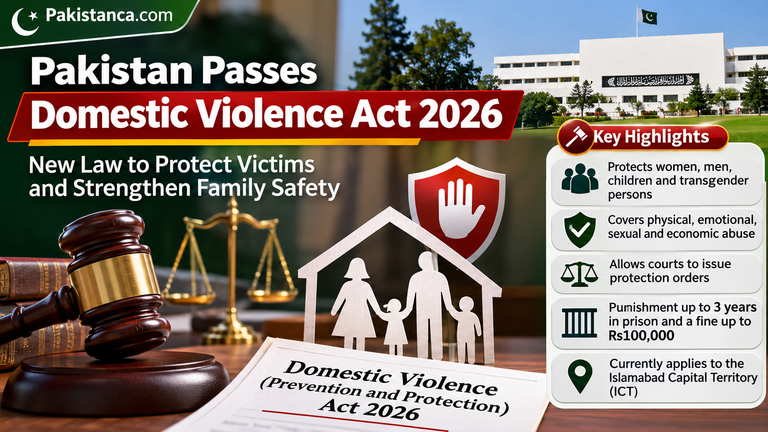
Pakistan has taken an important step towards protecting people from abuse at home through the Domestic Violence Act 2026. This new law aims to protect victims of domestic violence by providing legal support and stronger protection measures. President Asif Ali Zardari approved the legislation on January 26, 2026.
What Is Pakistan’s Domestic Violence Act 2026?
The Domestic Violence (Prevention and Protection) Act 2026 is designed to address different forms of abuse within households. It recognizes that domestic violence is not limited to physical injuries but can also involve psychological and sexual abuse.
The law aims to help victims seek legal assistance and protection through the courts.
Who Will Be Protected Under the New Domestic Violence Law?
The legislation covers several groups of people, including:
- Women facing abuse at home.
- Men experiencing domestic violence.
- Children living in abusive households.
- Transgender persons.
- Elderly individuals.
- People with physical or mental disabilities.
- Other vulnerable individuals in domestic relationships.
This approach makes the legislation broader than a law focused only on one gender.
What Types of Domestic Violence Are Covered?
The Domestic Violence Act 2026 recognizes different forms of abuse, including:
Physical Abuse
Physical violence and actions that cause bodily harm or injury to another person.
Psychological and Verbal Abuse
Repeated insults, humiliation, threats, stalking, harassment and behaviour that damages a person’s mental well-being.
Sexual Abuse
Conduct of a sexual nature that violates another person’s dignity or causes harm.
What Legal Protection Can Victims Receive?
The new law gives courts several powers to protect people facing domestic violence.
These include:
- Issuing protection orders against an alleged abuser.
- Restricting unwanted communication and contact.
- Ordering an individual to stay away from the victim.
- Directing an abusive person to leave the household in serious cases.
- Providing financial relief for medical expenses and other losses.
- Arranging temporary custody and safe accommodation where appropriate.
Courts may also direct police officers to assist in implementing protection orders.
What Is the Punishment Under the Domestic Violence Act 2026?
Under Section 4, domestic violence offences covered by this Act that do not fall under the Pakistan Penal Code can carry:
- Imprisonment ranging from six months to three years.
- A fine ranging from Rs20,000 to Rs100,000.
- Compensation of Rs20,000 to the affected person.
A separate provision also provides punishment for violating protection, interim, residence or custody orders.
The punishment depends on the nature of the offence and the applicable legal provisions.Official National Assembly of Pakistan website: https://www.na.gov.pk/
Does the Domestic Violence Act Apply Across Pakistan?
One important detail is that the Domestic Violence (Prevention and Protection) Act 2026 currently extends to the Islamabad Capital Territory (ICT).
This means it should not be described as automatically applicable throughout Punjab, Sindh, Khyber Pakhtunkhwa and Balochistan.
Each province has its own legal framework and relevant legislation concerning domestic violence.
Why Is This Law Important for Pakistan?
Domestic violence can affect individuals from different backgrounds and age groups. Many victims struggle to seek help because of fear, financial dependence or social pressure.
The new legislation provides a formal mechanism for victims to approach the courts and seek protection.
Its successful implementation will depend on public awareness, effective protection services and timely legal assistance.
Note:
Pakistanca.com will continue to share important updates about Pakistan’s laws, public policies and national developments.
FAQs.
1. Has Pakistan passed the Domestic Violence Act 2026?
Yes. Parliament passed the legislation in a joint sitting on January 23, 2026, and President Asif Ali Zardari approved it on January 26, 2026.
2. What is the official name of the law?
Its official name is the Domestic Violence (Prevention and Protection) Act, 2026.
3. Who is protected under this law?
It covers women, men, transgender persons, children and vulnerable individuals in domestic relationships.
4. What is the punishment for domestic violence?
For offences covered by Section 4 that do not fall under the Pakistan Penal Code, punishment can include six months to three years of imprisonment and a fine of Rs20,000 to Rs100,000, along with compensation.
5. Does this law apply in Sindh and Punjab?
No. This particular federal Act extends to the Islamabad Capital Territory. It does not automatically extend to Sindh, Punjab or other provinces.
6. Can a victim request a protection order?
Yes. An affected person can seek legal protection through the procedure provided under the Act.
7. Can a court order an abusive person to leave the home?
Yes. In serious cases, the court can issue an appropriate order requiring the respondent to leave the household to protect the affected person.