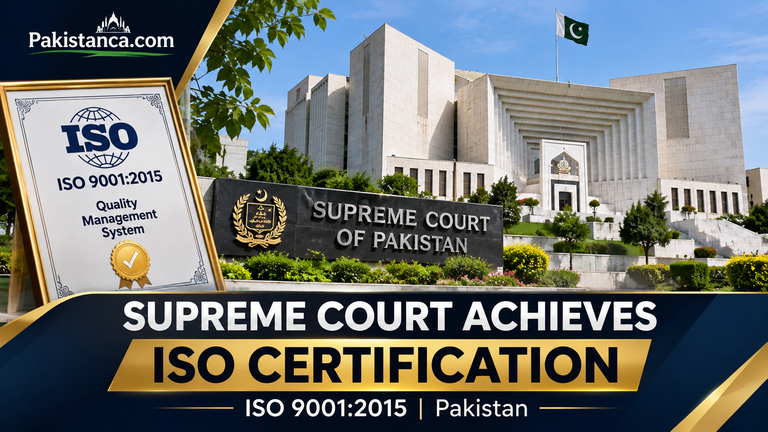
The Supreme Court of Pakistan achieves ISO certification for its Quality Management System (QMS), marking an important development in judicial administration. The certification aims to strengthen transparency, accountability, efficiency and public service delivery in Pakistan’s highest court.
The Supreme Court of Pakistan received ISO 9001:2015 certification following a successful assessment against internationally recognised quality management standards. The certification was issued by INTERCERT on November 19, 2026, as part of the court’s ongoing institutional reforms.
Supreme Court Receives ISO 9001:2015 Certification
The ISO 9001:2015 certification recognises the Supreme Court’s quality management framework and standardised administrative processes. It reflects efforts to improve the management and delivery of judicial services.
The certification covers several judicial functions, including:
- Civil and criminal appellate cases
- Rent and family appeals
- Review of judgments and court orders
- Contempt of court proceedings
- Issuance and enforcement of judicial orders and decrees
These functions form an important part of the court’s responsibilities in handling legal cases and providing judicial services.
For more information, visit the official Supreme Court of Pakistan website for judicial updates, announcements and court information.
What Does the ISO Certification Cover?
The certification also covers the administrative functions that support the judicial system. These include registry operations, case management, handling court records, summoning documents and publishing and archiving judgments and legal precedents.
To achieve this certification, the Supreme Court introduced a Quality Management System supported by documented procedures, standard operating procedures (SOPs), clearly defined responsibilities and an institutional quality policy.
The system also includes internal audits, performance monitoring, risk assessments and corrective measures.
How Will ISO Certification Help Litigants?
The new quality management framework is designed to improve the experience of litigants, lawyers and other people who use court services.
The standardised procedures aim to:
- Reduce administrative delays.
- Minimise unnecessary visits to court offices.
- Improve the accuracy of court-related information.
- Strengthen case management procedures.
- Improve consistency in administrative services.
- Promote transparency and accountability.
These improvements are intended to make court-related administrative services more efficient and accessible.
Supreme Court Continues Judicial Reforms
The ISO certification is part of wider judicial reforms introduced by the Supreme Court of Pakistan. Other initiatives include digitisation of court records, e-filing, electronic certified copies, improved case management and public facilitation services.
Together, these reforms aim to simplify court procedures, improve institutional efficiency and support better access to justice, including for people living in remote areas.
The achievement represents another step towards strengthening institutional performance and introducing internationally recognised quality management standards into judicial administration.
For more information and the latest updates, visit Pakistanca.com, your source for news and updates from Pakistan.
FAQs
What ISO certification has the Supreme Court of Pakistan received?
The Supreme Court has received ISO 9001:2015 certification for its Quality Management System.
When did the Supreme Court receive ISO certification?
The certification was issued on November 19, 2026, by INTERCERT.
What does ISO 9001:2015 mean?
ISO 9001:2015 is an internationally recognised standard for quality management systems that focuses on consistent processes, customer or service-user satisfaction and continuous improvement.
How will this certification benefit litigants?
It aims to improve administrative efficiency, reduce unnecessary delays, improve information accuracy and make court-related services more consistent.
Which services are covered by the certification?
It covers judicial services, registry operations, case management, record management, judgments and related administrative functions.